Shaun Levin

Archive for the ‘Writing’ Category

Almost There: Joy and Fear

In Writing on February 27, 2018 at 3:32 pm

There’s a book I’ve almost finished but I’m doing everthing I can to avoid it. The manuscript is on my desk. I know exactly what I need to do. The ending needs to be written. It’s a happy ending after a lot of turmoil and loss and violence. Something good happens at the end and I know exactly what it is, and most of it is written already. If I sit down, it’ll be done in 3-4 hours. It really will. All I need to do is sit there with the mansucript and with my keyboard and go paragraph by paragraph and write down the story as it happens.

I know what happens.

Is it fear? The fear of the completed project. The fear of having to put the book out into the world. The fear of saying okay this is what I’ve been working on for the past 2, 3, 6 years, do you like it? But those feel like the cliched answers. It’s not fear. It’s something else. It’s the power of fiction, I think. The overwhelmeing rush you get when you create a scene that is completely fiction, a creation of your mind, a fantasy you have of love and joy and meeting The One. At the end of the book he meets The One. The story feels so real, the happiness is so real, and I guess because it’s at the end of the book there’s no room for negativity to snake its way in.

Maybe the fear is joy. It’s not fear, it’s joy. Me and joy. We have a complicated relaionship. I have always resisted the endings of projects. When I was part of a professional supervision group, they bribed me with chocolate cake as an incentive to finish my first book. They didn’t actually bribe me, I made them promise to buy me the cake if I finished the book. Now I’ve bought myself a sofa, so I owe it to whoever – me! – to finish the book. The sofa must be earned. The sofa is a gift for finishing the book.

It’s not joy, either. Not fear, not fear of joy. What do you do with a book that is done? You look after it. You find it a home, you do your best to make sure people like it, you find people to like it, you show it to people, you say nice things about it, big it up, feel proud of it, keep your doubts to yourself, make sure it gets the best care possible. If you finish a book, your capacity for support is tested. How well do you care for your books? Some people care for their books very well. Some people will do anything for their books. Some people are embarrassed by/for people who’ll do anything for their books.

The truth is that I’m not sure why I’ll do anything to avoid finishing the book. How about I shut up now and go finish it. A few more pages and I’ll be ready. See you on the other side.

Thoughts on Submission

In Writing on July 27, 2016 at 11:29 am

ClickHereToSubmitI’ve been submitting a lot lately. It’s fun to submit. Always? Often. Often it’s fun to submit. For a while I stopped submitting. Novels, stories, essays, flash fiction. The lot. I’d had enough. Submission wears you down. You know what it’s like: You have these stories you’re sure are right for them, so you send them to them. Or you have a few stories that have been lying around for ages – years! – and they need a home, so you risk it. You aim high. The New Yorker. The Paris Review. Or you aim a bit low. High or low, sometimes neither wants your submission.

Look long enough at a word and you start seeing its other meanings. In the world of writing we seem to ignore the submissive side of submitting. We go for the proactive aspect of submission, not the masochism of the sub-dom world. But it’s there. It’s there. We fear and loathe and are fascinated by submission submit. When it works, it can be transformative. We crave the acceptance of the one we submit to. Especially when our submission is honest and true and in compliance with everything they’ve asked for, then the rejection is bitter and demoralising and makes us wonder: Am I being a good submitter? A good submissive?

What does it take to be a good submitter? How do you choose the right people and places to submit to?

At least when you submit to a journal, the rejection feels less personal, but when you submit to an agent – it’s personal! They don’t like your work. They said no. They’re just not into you, and that hurts. Of course, we move on. Eventually we move on. Recently my friend M submitted to an agent whose attitude he liked. The agent was enthusiastic and dedicated and pushed their authors into the spotlight, got their books written about in all the major papers. My friend wanted that agent to be his agent. He didn’t love the authors the agent represented but he loved the agent. The agent said no.

“I’m not surprised,” he said to me. “I don’t even like the writers they like.”

“You’re rationalising your hurt,” I said.

“They should have loved me,” he said. “I’d have been good for them.”

Submit to places and people who love the work you love. If you don’t love the work they love they probably won’t love yours. Obviously that’s not always true, but mostly it is. Another friend of mine was determined to be published in a certain journal. He liked the vibe surrounding that journal. Cool people hung out there. My friend read their back issues and worked out what these people were into. He wanted to be amongst them, for his voice to be amongst theirs, so he studied how they did it and wrote a piece he was proud, albeit a piece he wouldn’t have written if he hadn’t wanted to be in that journal. He wrote it for himself but he also wrote it for them. It’s a delicate balance, he told me, and one that he enjoyed trying to maintain. They liked the piece and said yes and now he is amongst the cool people.

“It’s not the first time,” he said, and told me how back in the late 1990s he’d written a story for a porn magazine and the people at the porn magazine had loved it and paid him for the story and told him to send more; his fee would increase incrementally with every story he published with them. He tried, but he couldn’t do it. The kind of story he sent them wasn’t in a style he could sustain. It didn’t come naturally. He’s also the kind of person who, if you say yes to him, if you say I love you, he freezes up.

All writers keep getting tangled up in the Venn diagram wheels of exhilaration and devastation.

Find the places you want to be published in, absorb the kind of work they like, then write something for them. Write something for them that you’re going to enjoy writing, that will challenge and educate you. This experience will expand your range as a writer and you’ll get a kick out of it. Find the strength in being a sub. Submit to places that will help you grow, places that will get your name out there, places that will push you to write outside your comfort zone. Pick your play partners carefully.

We all want to be rescued from the desert islands of our writing desks. Don’t submit just because you want to be rescued. Nobody likes a clingy bottom.

Submission is the relinquishing of power. You are not relinquishing the power to define who you are. Do it in a way that feels integral to who you are. If something doesn’t feel right, trust your intuition and don’t do it. On the other hand, do it and see what happens. It’s not like you’re being tied to a St. Andrew’s Cross with the whip of an evil dominatrix lashing against your back. It’s only one story of many. Submit and see. Submit wholeheartedly. There are hundreds of places out there to submit to. As the Hebrew saying goes: Le’kol sir yesh michseh. There’s a lid to every pot.

Submit in order to let go of stuff. The more you submit, the more space you make for other work. Submitting is a way of letting go. One of my yoga teachers has this thing at the end of a session when we’re all lying in corpse pose and at some point they’ll say, let go, let go, let go. At first I wanted to laugh. What a hippy thing to say! What a cliché! But then I grew to like it, to just do it, to try and let go, let go, let go. Because what I noticed is that once I let go, I felt stronger when I emerged back out into the world.

Submit in order to let go.

And remember. Writing. We’re in it for the pain. We’re in it for the joy.
Wrestling with a Story

In Writing on April 5, 2016 at 8:18 pm

First person or third. I can’t remember which came first. I may have started the story in first and then translated it  into third, or maybe it began in the third person. The story is autobiographic-ish, based on someone I know, someone I was kind of in love with but who wasn’t in love back. The story was a What If. What if we’d taken everything to its extreme. It’s not a story with a happy ending.

A few years ago I finished the story in the third person and sent it off to a competition and it won. I don’t remember what the competition was called and there was no big hoo-hah around it, but it was nice to win – it’s always nice to win – and there was even a bit of cash involved. You’d think that would set the story in stone, that acceptance would be the end of it. But the story never got published – it wasn’t that sort of competition – and it’s hard to let go of an unpublished story.

Print is the final goodbye. I know that’s not entirely true, that writers like Raymond Carver changed stories radically from one printing to the next, say from printing in a magazine to the story’s appearance in a collection, or from one collection to another. I don’t want to spend these twenty minutes doing research, but I think it was a story that appeared in What We Talk About and again in Cathedral. Was it “Small Things” that was also called “Popular Mechanics”? Am I it’s-all-coming-back-to-me correctly?

Now as I write I’m asking myself: Why not try the second person? I’ve always liked the intensity and intimacy of the second person. It often feels like the most creative voice to hide behind when writing autobiographical stuff.

The struggle is… the grappling is… the wrestling with the story happens when the right voice won’t make itself known to you right away; the pen takes a while to get on the scent. You have a story, you know pretty much what you want to say, but finding the voice in which to tell it, is not so easy. Eventually you have to let go. Putting a story into a collection or getting it published is one way to stop wrestling with it.

I had a story like that in my first collection. I think it was called “Everything is Sweets” or something like that. I fought that story for years, maybe close to ten years, it hung around and kept changing , kept not being in the right voice. Bits of the story itself changed, things got added, taken away. I couldn’t tell you what got lost and gained along the way. It got published. I let go.

On some level, one wants a story to reveal itself to you, to tell you what it needs. The way a good lover will tell you what they need to be happy. At the moment, the story is being difficult and it wants me to work out why. You figure out what I needs! It’s giving nothing away, no clues. If only I knew the right words, I could make it run smoothly. Something’s missing and I’m not sure what. Yes, the voice isn’t right, but the voice will bring the right story with it, too; the right voice let me know what’s missing from the story or what needs to be taken out. The voice will tell me the story.

So I continue to wrestle. Or at least that’s what I should be doing, instead, I’ve walked away, gone to other stories and let the difficult story simmer, or sulk, or rest, or get some distance – give me some space! – or whatever it is that I need or the story needs to become clearer when we meet again. Maybe there’s a truth in the story that I’m not ready to hear. Maybe the story has something to tell me that I’m not ready to face. Maybe, and isn’t this the case with the creative process in general, one of us needs to submit. And seeing as there’s only one of us here, that one of us will have to find a way to quietly submit to the story.

Next time: Let’s talk about submission.

Time for a New Book

In Writing on April 3, 2016 at 2:51 pm

Not until you start putting together a collection can you know what it’s about. In the beginning, the motivation is the idea itself. A book. A new book. It’s been a while since the last one. You have, in a variety of folders on your desktop, various stories and essays that have been published over the past 24 years. You start by creating an inventory, the first draft of a contents list. You create a new folder and copy into it all the pieces you’ve already published, minus all the stories that appeared in your first collection ten years ago. The truth is, you finished a novel and sent it out to a million agents – at least a million – and to some publishers, and 10% of them sent back their no-thank-yous. The rest, if one was the waiting type, one would, eighteen months later, still be waiting for. You figure that in the meantime you might as well put together a collection of stories and essays.

At the new bookshop up the road, you stumble upon Hanif Kureishi’s Love + Hate: Stories and Essays, and you take it as a sign that the two things (things?!) can go together. You fell out of love with Hanif Kureishi about ten years ago, but this book has revived some of the love you’d lost.

So, once you’ve packed the folder with your stories and essays, you print them out.

By you I mean me. I.

I’m surprised how many there are. I give myself a pat on the back. Well done you. Well done. Not bad at all. Already I’m feeling better about things. The piece I like the most is a gratitude piece, a list piece about the writers and other humans who’ve made me the kind of writer/human I am today. The essay was published in a collection three years ago. It feels like a good place to start. The call in the call and response. The response being the rest of the book-to-be.

The New York piece comes after that, then the piece set in Abney Park Cemetery, then another one and another one, and a theme starts to emerge. A book that was going to be a collection of twenty years of sex writing, is turning into a book about immigration, London, Tel Aviv, rootedness, rootlessness. The pieces seem to flow from one to the next. The book gains its own momentum.

Shaun Levin edited page

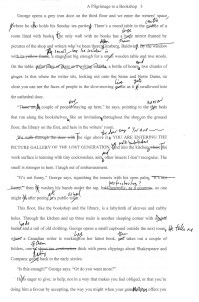
From an essay on Shakespeare and Co Bookshop in Paris. Originally published in Hebrew in Masa Acher, a travel magazine.

You read through the book. You edit as you go along. From a distance of 10 years, 5 years, a couple of years, it’s easy to be ruthless, enjoyable even. Look how sharp I am. I feel focused, clear. It’s like you’ve been training for this. It feels strange not to be tormented by doubt and the chaos of creation. Cleaning things up is fun. Being streamlined.

Then you get to a story that refuses to comply.

To be continued.


Natalie Goldberg and the Uncertain World of Notebooks

In Writing on June 25, 2014 at 3:37 pm

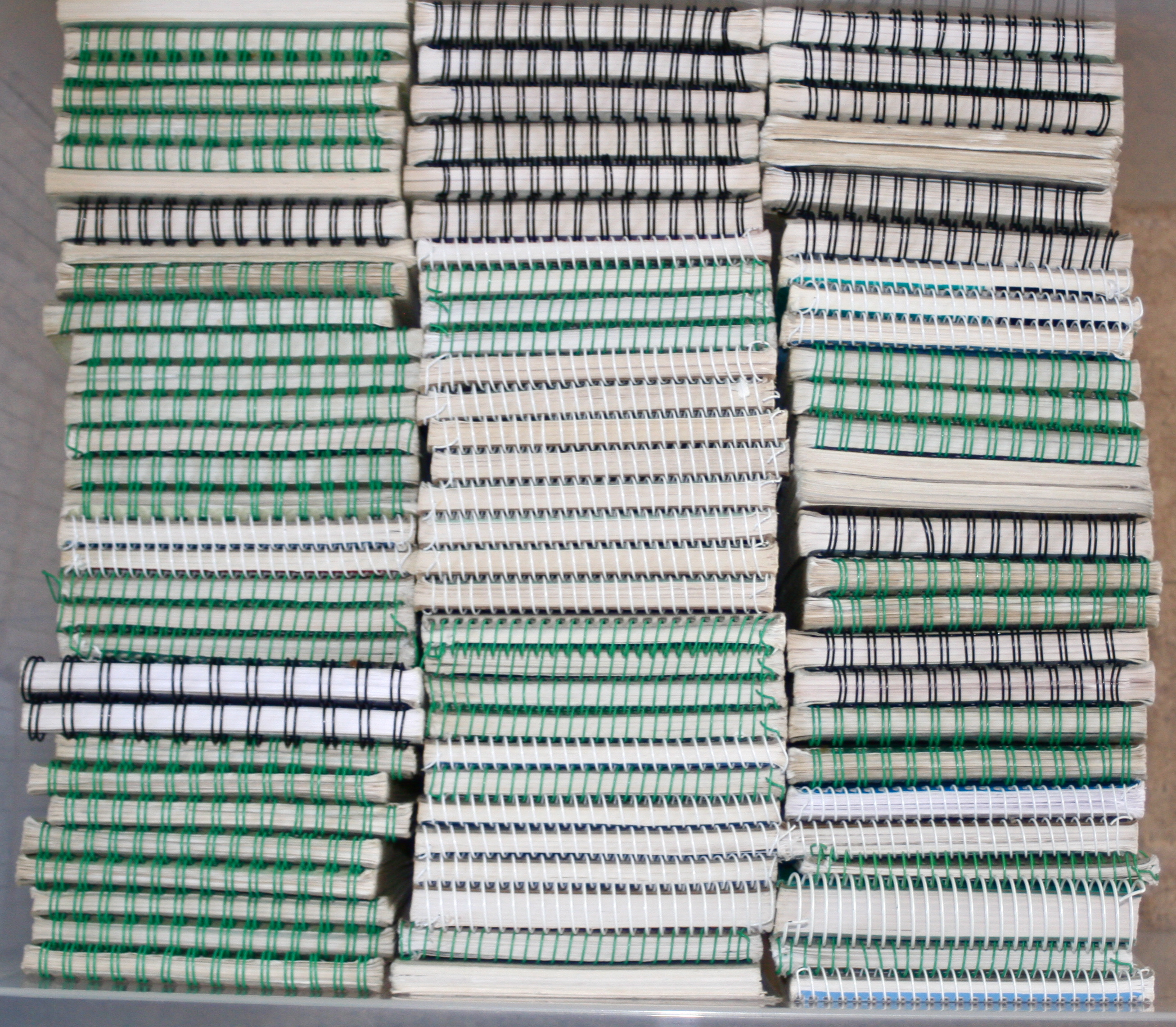
Spiral-Bound NotebooksFor a long time I did what Natalie Goldebrg told me to do. Cheap notebooks were the best, she said, not the fancy ones that make you feel precious about your writing. Keep it simple. So for many years I wrote in spiral-bound A5 notebooks. I wrote with a blue biro, and only blue would do. I met people who wrote in other colours: black, green, someone’s husband used a brown pen, and there were those who’d write with whatever was at hand. Some people weren’t picky. I was picky, and pickiness is a form of superstition, a way to ward off dread. For years I wrote like this in notebooks with 80 sheets, ruled lines, some were perforated, but it was bad luck to tear pages out of a notebook. I’m not sure where I got that superstition from. Many of my superstition are of my own making.

I wrote a lot in those years, almost every day, starting from around 2006 when I first came to London. Natalie Goldberg said to finish a notebook a month, so I did. Some months I was close to the end of the month and still had blank pages untouched, so I wrote to fill the pages, because that’s what I’d committed to doing, what I thought one did to hone the craft. When that happened, I allowed my words to get bigger, letters took up two lines, doubled in size, ten words per page. Anything to finish the notebook, to move onto the next one on the first of the month. I liked the freedom of the bold handwriting, something I didn’t give myself much license to do. I stuck to the lines and stuck to my monthly quota. One notebook per 28, 29, 30 or 31 days.

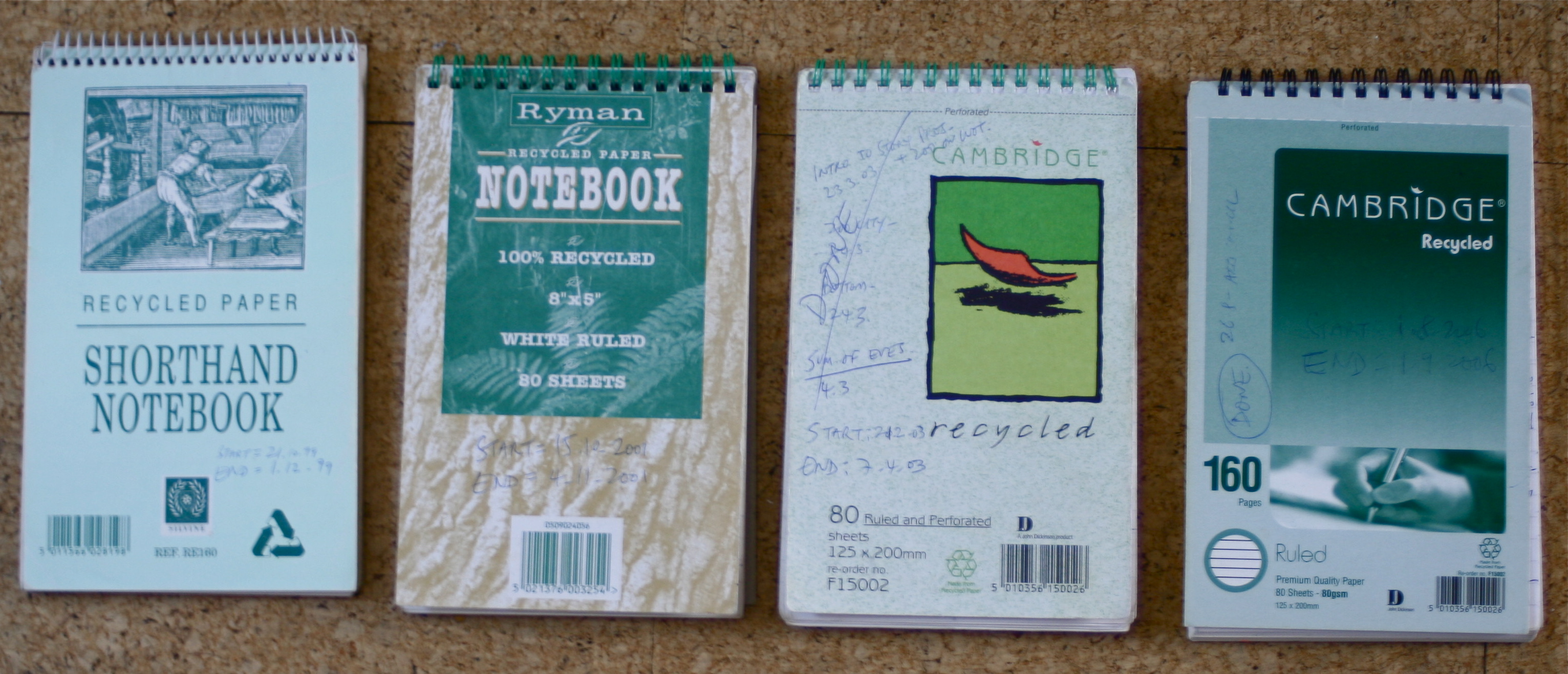
4 Spiral-bound NotebooksRyman’s used to make a recycled spiral-bound notebook. It was the perfect notebook, and when they stopped making it, I called up head office to ask if they had any left; I was willing to buy whatever stock remained. It was like my rabbit’s foot, my shark’s tooth, my rusty horseshoe had been stolen. But they had none and I moved on, found something similar and forgot about the Ryman’s 100% Recyled 8″ x 5″ spiral-bound notebook until I sat down to write this.

Time passed and things changed; I got busier, needed more than a month to finish a notebook. But I was loyal to the notebooks with the light green covers, the thin paper, the ruled lines. I bought them in bulk from Viking, the office stationery company. When I look back now it seems strange to me that I wrote on lined paper. Recently, someone commented on how straight my lines were – “typical writer,” she said, though I don’t think she knows any – and perhaps those ten years of writing on straight lines have been absorbed into my system, so that when I shifted to the thin plain pages of the Moleskine, my lines were already ingrained, part of the way I saw the page, like those lined pieces of card we’d put under blue onionskin airmail paper when we’d write to people abroad.

About five years ago, a lover came to stay for a while. He was visiting this island from the island he is from. He brought me Mitsubishi Uni-ball Signo DX UM-151 0.5 gel pens in various colours: pink, green, dark yellow, purple, orange. I’m not sure how it happened or why – maybe I was ready for change, ready to try something new, or I wanted to show him I was using his gift, the way you use a gift to mask your ambivalence in the presence of the giver. This was the type of pen he wrote with in a language that calls for fine-nibbed pens; that, or soft calligraphic brushes. By then I was writing in Moleskine notebooks, though I don’t remember the moment my notebooks changed, when I went from the soft covers of the A5 spiral-bound notebook to hard-backed pocket-sized notebooks with double the amount of pages.

Moleskine SpinesFor about 6 years, maybe more, I’ve been writing in black Moleskine notebooks. When a friend gave me a green hard-backed Moleskine notebook last week, I faltered. I couldn’t imagine writing in a notebook other than the exact notebook I’ve been writing in for years. The repetition, using the same notebook over and over, creates a sense that multiple notebooks are one Notebook; after a while, you stop noticing the colour, shape, cover of the notebooks you’re using. Repetition allows you to forget. You don’t have to remember whether it’s the blue one you took to Paris, the yellow one you wrote in while on retreat in Scotland, or the beige one you record your dreams in. On the day he gave me the green notebook, I didn’t have my notebook with me, so I accepted it, cautiously, my superstition unseated.

I’m not always sure exactly when things changed, when I went from spiral-bound to Moleskine, the way I know the precise moment when I moved from blue biro to multi-coloured pens. So now I mark this date, Saturday the 21st of June, the day I ventured into multi-coloured notebooks. I recently started using a black pen, albeit from the same make as the coloured pens. I’ve been experimenting with drawing and black feels like the right colour to do this in. So that’s where things stand at this point in time.

The Consequences of a (Violent) Scene

In Writing on August 23, 2013 at 12:24 pm

It’s a difficult scene. For a while now, you could tell that it was coming, and then it’s here. Three days you’ve been circling it, jotting down notes, working on what comes afterwards. But you’ve resisted going into the cold hard fire of it – the heart of it. That’s a quote from somewhere, or part of a quote, but you can’t remember who said it. It’s not Kafka’s “cold abyss” of the self, but maybe it is that, too. It’s a violent scene. People get hurt. Do horrible things to the characters who are your friends, characters who are close to the character who is closest to you.

Nabokov's DozenYou open a book of Nabokov’s short stories, the one you keep in your desk drawer, the one you use to kickstart a paragraph every now and then, something that’ll take you in an unexpected direction, wake you up. The line is “He had spent all his life in Berlin and its suburbs; had never travelled farther than Peacock Island on a neighbouring lake.” And you get your narrator to say: “I have spent all my life afraid of violence…” And for a while that keeps you going; it’s fuel enough for 5 or 6 lines. The energy of Nabokov’s writing never fails to power your own. But then you run out of steam, or you chicken out.

You wonder if your resistance is perhaps a sign that this scene doesn’t need to be written, that it’s not the right scene for the book and maybe you’re just adding high drama because someone said – whose rule was it? – that you should make something bad happen to your character just to see how they’ll deal with it. How they’ll deal with it?! How am I supposed to deal with this level of brutality?

It’s not the first time you’ve questioned where the drama should be in your novel.

Is it really necessary to the story? And if you have this unexpected scene in the book, this scene that has suddenly appeared in your third draft, like bad news, like a skiing accident, then what’s going to happen to the rest of the novel, those 30,000 words that come after the scene?

What you really wrote was: I’ve spent all my life fearing random violence and its consequences.” The consequences of a new and unexpected scene in a novel. The unexpected is not something I cherish. I mean relish. So what exactly are you scared of?

  • unnecessary drama
  • violence
  • the impact on the rest of the book
  • that it’ll sound fake
  • that I’m being dishonest
  • that a violent scene messes with my plan to make this an upbeat book

“So I sighed a little, and decided to go.” Another Nabokov line. A just do it line. And another: “He slept badly the night before the departure.” It’s true. I’ve been blaming it on the full moon. Yesterday I was so jetlagged with exhaustion that I couldn’t bring myself to write, not until almost midnight, but today I am back and sighing a little, dipping in and out of the scene, writing bits of it. threads, patches, things that will – have faith! – eventually get woven and sewn together and whatever the consequences turn out to be, you’ll just have to deal with them. Now, go! Write!

And what’s the worst that can happen? You’ll write it and it’ll be wrong and you’ll start all over again. But at least once you’ve written it, it will have been written.

How I Met My Writer Friends*

In Writing, Writing Workshops on July 7, 2013 at 8:52 pm

We met at a reading.

I don’t remember where we met.

We met at a prize-giving where we both won a prize. You were there with your boyfriend and I might have had a boyfriend, too, but I don’t remember. I had quite a few boyfriends in those days. We all went to a bar after the prize-giving in Covent Garden and then we carried on meeting regularly. We wrote together. I liked writing together. Writing with you changed the way I write, opened up a whole new way of approaching my subject matter: Me. We fell out some years later but have recently got back in touch. I think we like each other. I probably fancied you for a while back then, or was jealous of you, which sometimes amounts to the same thing.

I met you in Wales on a writers’ retreat more than fifteen years ago. We laughed a lot and liked each other’s writing. We hadn’t published any books back then, maybe a few stories, but we were writers. We weren’t going to become anything else. There were others there, but I only remember one of them, and she did become a writer, she was a writer already, and went on to publish a book, maybe two, but we didn’t stay in touch. We tried to, but she lived in another city and I’m not so good when it comes to travelling. You lived just outside London and we met regularly, shared work, wrote together. We published a few books each. There was always a bit of competition between us. I tell myself it’s mainly from your end, but that’s probably not true. I’m not very good at admitting to my competitive side.

People ask us where we met and neither of us can remember. It might have been at a book event or we might have been introduced to each other through two or three mutual friends. I’d heard about you and read your work before we met.

We were both reading that evening at an event in a private gallery in someone’s house in North London. I think that was the first time we met. I loved your work and I loved the way you read and I wanted to be your friend. We were friends for a long time. We wrote together. I loved watching you in public. I loved watching you perform and read your work. I loved the way you dressed. We, too, fell out after a few years, and we, too, have been in touch recently. We’ve had dinner a couple of times, and spoken on the phone. I’m seeing you in the next couple of weeks. We are similar in many ways. We both moan about our lack of recognition. We’re both foreigners in this city.

We met… where did we meet? I don’t remember where we met. We’ve been friends for a couple of years, maybe a bit more, and we talk a lot about writing. I like our conversations about writing. We used to write together every week for a few months, but then we stopped because you wanted to stop, because you said you preferred to write alone. I miss writing together.

Sometimes a few of us get together at dinners, usually at my place, and we have a good time together. Some of us know each other from various places and networks. We’ve all heard of each other, or at least most of us have heard of each other.

I met you at an event in South London where we were both reading. I’d heard about you before, maybe we were friends on Facebook before we met. We have friends in common and we are neighbours and we both love to eat meat. So we hang out every now and then and eat meat and talk about writing and what it’s like to be a bit unhinged, much more unhinged than some people we know.

We met because of a mutual friend. We meet every month or so and do writerly things. We both like coffee and cake and we both like to do Jewish-y things and go to places that are linked to the projects we’re working on. We like each other’s work, the work that we read to each other when we meet up to go places and write, though I have a feeling you’ve never read my work.

When we’re together I am who I’m meant to be. I’m in the world as a writer and I feel alive and abundant. I like it when we write together. If I could, I would do all my writing with you. And you. And you. I don’t always like being alone in a room writing, which is probably why I enjoy writing in cafés and art galleries and parks and wherever I can that is not at my desk. I write there with you or with people around me, one of whom could be looking at me and thinking whether to get up and approach, whether to sit down on the bench next to me with their notebook in their lap and silently, without saying a word to each other, because all words must be saved for the work, lift their pen to that blank page and write.

* written in response to the question: Where can I meet other writers?

On the Importance of Having Unread Books on Your Bookshelf

In Writing on May 23, 2013 at 1:25 pm

Unread books wait on our shelves, full of potential, their knowledge imminently ours. Unread books are stories we avoid, gifts we were given, memories sculpted in time. Unread books are objects, the picture on the cover, the words on the spines, the place of purchase. Was it the Bodhi Tree on Melrose, or Housing Works near Broadway, or Skoob Books before Skoob Books moved to the Brunswick Centre, or that place on Ben Yehuda Street, or the bookshop in Sydney when we lived near Nowra and ran out of books to read and they’d mail the books to the post office in town and we’d drive for miles to pick them up? Unread books are in our living rooms and bedrooms, some in the loft or the kitchen. Unread books are a secret; they are who we are. Unread books are partially read. Some are almost-reads. An unread book signed by its author is hard to give away, especially if our name appears in the inscription. For Shaun. With best wishes. Unread books reassure us. Unread books are wishes. They wait. We like to be waited for. Unread books tell us that we have things to do, that we can’t go now, not now and not for a while yet. Unread books ward off death. Unread books are a title and its promise. Unread books are written by friends we wish were better writers than they are. Guilt and duty keep us from discarding those unread books, or taking them to the charity shop where proceeds go to a cat shelter. We’d like to like some unread books more than we do. We would read them if we had more of an open-ended sense of time, an occasional glimpse into infinity. Unread books are who we are in our best moments, mirrors and reflections and badges of erudition and originality. Unread books are by authors who wrote a book that we loved and expected to love this unread book as much as the other. We thought we’d love it when we bought it in another city, but when we got home we found that we no longer loved the book, now we hope that one day we’ll recapture that love and the person we were when we bought the book that is still unread. Unread books hold the past. They are books we want to love. Unread books impress, make us look good, they are the books we want to be thought to have read. Unread books are similar to the books we’re writing, similar in style or subject matter, and so we believe they’ll inspire us, help us broaden the scope of our work, but that’s not what happened. After the first few pages, we balked. Unread books are books we keep regardless. Unread book have something important to tell us, something significant to contribute to our work and our life. Unread books will expand our world, give us insight and greater confidence. An unread book is someone we want to meet, a place we want to go to, a life we want to lead. Unread books are books no one else has, rare books, first editions, books we’ll never get to. An unread books is a guide to something we wanted to learn, but time has passed and that desire has passed, too, and to get rid of the book is to admit that the skill or the knowledge will never be ours. Unread books are evidence of a disappointment. Unread books are big books given to us on special occasions, books we’ve had for years, carried from house to house. Unread books have been places. Unread books are a promise of languid days, written in genres we steer clear of, from points of view that seemed intriguing – a chimpanzee’s perspective, the voice of a dog, or someone who has died. We’d planned to imitate the unread books, study them, devour them, but they proved too challenging or not challenging enough, nor inspiring, yet we didn’t blame them entirely, but ourselves, too, for we are impatient and judgemental. Unread books are gifts from people we dislike, people who angered or hurt us. Whatever they gave us is contaminated with those feelings. They thought we’d like the book and, because they knew us well, they were right. In time, we will extricate the book from their clutches, overcome the memory and enjoy the book just as they knew we would. Unread books are about us and about our people, our race, our profession, our sexuality, our ethnic affiliations, our gods. Unread books are some part of us we’re not ready to see closely. Unread books are too big for bed, too bulky for a bag, too heavy for the sofa. Unread books look good on a shelf. Unread books have interesting titles, like Decent Passions, or The Poetics of Space, or Voices of Time, or The Complete Guide to Self-Publishing. An unread book is sometimes an unfinished book, one we started and abandoned but kept because there have been other books we’ve started and not finished and then revisited and relished. Unread books become read books. Unread books are biographies, letters, diaries. Unread books will validate our choices and misfortunes. Unread books are millions of new sentences and new ways of configuring the order of words. Unread books defy our rules of book-culling. Some have not been read in the past two years nor will they be read in the next two, yet still they remain. Unread books cling. Unread books are not people. Unread books will rock our world. An unread book is the wise person we meet on a journey. Unread books are more than their words. Unread books are the author’s picture and the paper and the font and the dust jacket, and the sticker on the back if we bought it in a second hand bookshop, the markings inside, the highlighted words, the notes in the margins, ours or someone else’s. Unread books were bought with a project in mind, or a friend, or something or other that never materialised. Unread books answer unasked questions, shed light on our stories. Unread books are tarot cards. Unread books are for when the momentous thing happens, the thing that will need the solace that a book can give. Unread books rely on the reading of another book or the seeing of a film or a trip to a certain place. Unread books require another act. Unread books are books we want to have read. Unread books make us look tolerant, erudite, humane, intriguing, original. Unread books are books we will read, or should read, or would read if only we had the time and the urgency. Unread books will make us better people, especially books with titles like Men’s Friendships and Full Catastrophe Living. An unread book would help us if we’d let it. Unread books are a test, proof of an intention. Unread books are thwarted journeys. Unread books are a barricade. Unread books are company. Unread books are individuals and a tribe. Unread books are who we are when we are at our most vast, deep, complex, rich and resilient. Unread books are an echo of the world’s libraries. Unread books are a mating-call. Unread books are life.

Focusing to Let Go

In Writing on March 12, 2013 at 1:54 pm

Twenty minutes is about all L can manage. And that’s on a good day. Sometimes twenty seconds is a triumph. When he’s having a boxing lesson at the gym, 20 seconds is a lot. He worries about what people around him are saying. He worries that he’s not very good and that he looks ridiculous and what made him think he’d ever be able to box. He used to fantasise about being able to dance, learning ballet, and when he looks at the boxers training – sparring, not fighting – they look like ballet dancers. The grace, the speed, the control that seems effortless. That’s how L wants to move, and with the added perk of being able to protect himself. Every fighting art seems to have that grace, capoera, tai chi, karate, all seem linked to ballet, or all on the same continuum. Is that what dancing is, a way of protecting yourself? Are those the roots of dance, of speaking to the higher powers, the gods? As if to say: If I can protect myself then god will protect me. Or something like that. Is that the logic of it all?

So C is teaching L how to punch. The jab, the hook, the upper cut, and because they’re doing kick boxing, it’s the knees, too. Very rarely does it feel easy. L’s body feels awkward, rigid, and then when C demonstrates, L is in awe. He thinks: What will it take to be like that? Of course, there is also the distraction of C’s good looks. And people are watching. And the music is loud and L’s coordination is all wrong. How does one step and punch at the same time, or step, then punch. Focus, C says. Just focus.

C tells him that sometimes when he’s in a fight he’s so focused he can’t even hear the crowds, and when he watches a video of the match afterwards, he’s surprised at the level of noise in the place.

But every now and then L gets into a groove and everything disappears except the writing (weren’t we talking about boxing?). Nothing else matters. One moment you’re at point a, then you’re at point b and it feels like a miracle; you can’t remember how you got there! The strange thing about focus is that we do it to let go, to disappear. What C means when he says focus is to let go of everything else around you, to just be in the moment. Food doesn’t matter, nor fame, not even the bank balance, or love. Focus away from distractions, away from other people. He makes focus sounds like a precious thing, a transcendent state. Maybe that’s why L has never been a religious person. Faith is a type of focus.

Focus is a movement outwards into something bigger, stronger, a place where secret knowledge is kept, and it’s a feeling of moving out of your body, of dissolving into something, becoming diffuse. There is no whining in focus, no need and please. Focus is clear of whining. Focus is being in the place you’re meant to be in, not wanting to be somewhere else, not wanting more than there is at this moment in time. Focus is now. Focus is when the thing just keeps going and you don’t know where it’s going to take you and you don’t worry where it’s going to take you because you’ve let go and wherever you land is good. Your hands move and your feet move and there is grace and wonder and elation and smoothness and dancing and you’re floating and flying and diving deep and breathing without thinking about, like that moment at the end of The Big Blue when he finally goes into the water and swims deeper into the sea until there is just a spec of him in the distance.

Focus is letting the cake burn. Focus is not hearing the doorbell ring. Focus is not hearing when your name is called, when you head is buried in a book or in a story or in a game, buried so that you can’t hear the shouting or the laughing and maybe there isn’t any because everyone is so focused on doing what they’re doing, in the moment, in the running and jumping and boxing and lifting and writing and singing and dancing and shooting and grabbing and flying and floating until the very last second.

Too Much Drama Too Close to the Start

In Writing, Writing Exercises on March 6, 2013 at 12:39 pm

Sometimes you wake up into the hopelessness. What you’ve written is all wrong. That scene you’ve just spent the last few days writing threatens to topple the entire novel with its consequences. And, no, you are not catastrophising! Something as big as that scene should not be happening so near the beginning of the novel; there needs to be time for things like that to build up, time for that kind of crescendo or confrontation to happen. Even hope needs time. And redemption. Drama as big as that can happen later. Save it for the peak. A scene like that, with that kind of energy, can, before it appears, carry the tension and suspense of a novel for a good few chapters.

So what do you do with it now? Now that it’s been written and it’s all wrong.

Sit in it. Sit with the worry and the dread that you’ve messed up, that the novel is on shaky ground and it’s all your fault. You’ve ruined it. Sit with that. Make a cup of tea and sit in a chair you don’t often sit in and think about what to do. On a day like yesterday, after what has felt like, and has been weeks of grey skies, sheets of it weighing down on the city like an iron dome, you could sit outside in the sun. That’s somewhere you haven’t been able to sit very often recently. Sit in the chaos. Mythology teaches us that chaos cannot last forever. Even if it feels like it will.

The solution (ie. order) can only come out of the chaos. No distractions. No outside help. This is a big one and you need to go it alone. It’s your novel. To paraphrase the Abbess of Crewe, in her lofty calm: “There’s a novel going on, and you’re in it up to the neck, whether you like it or not.”

One solution is to mute the scene, to take the intensity down a notch or two. Save the major drama for later. The major drama you thought would happen now can be postponed; the muted version will create a hunger for more, a bloodlust for the real showdown. And that hunger will sit in the novel like a secret, like a time bomb, an IED, something waiting to be told, to erupt, to reveal itself when least expected. If you know that, the reader will get a sense of it and even if they’re not conscious of it, they’ll be waiting. And so will you.

Save the big drama for your own surprise.

Another thing to do with big drama that feels wrong, that feels over the top too soon, is to turn it into a what-if, an imagined moment. So if you’ve just written the scene in which she lunges for the woman in the department store who’s just called her vile names and yanks the earring from her ear, ripping apart the lobe, you could transform that into what the character imagining doing something so violent, a what-if scenario. And by doing that you will have 1) created a scene of intense drama, albeit imagined, and 2) conveyed the character’s capacity for acts of violence that will now sit in the novel like Chekhov’s loaded gun.

Sometimes the best thing to do is to go to sleep, and to wake up into whatever you wake up into. Sometimes the horror of having done it all wrong is the beginning of the solution. Without that, something not-quite-right might have stayed in the novel and done to it what you most feared it would. It might even have scared you off.

How do we get better if there is never a sense of failure, never a moment of wondering now what? Our mistakes can be an asset. They raise questions, things to grapple with that lead to answers, new ways of dealing with narrative that will then be available to us when similar problems arise in the future.

And yes, I know someone who did that to someone in a department store when she was in high school in North London. But that’s another story.