Shaun Levin

Archive for the ‘Writing’ Category

The Path of Unknowing

In Writing, Writing Workshops on January 2, 2012 at 6:52 pm

Sometimes someone says something you’ve instinctively known is true but have never managed to put into one sentence. While reading an interview with Andrew Sean Greer, I came across him saying that writing is about not knowing and being with someone who is not knowing

I just don’t think you should say anything to a novelist except to keep going, because they don’t know what they are doing so you can’t know what they are doing. They are really just finding their way in the dark.

that more or less summed up what I feel about teaching writing and the frustration I think we all feel, teachers of writing and workshop participants, if we start to think that one of us should know. I have always said in workshops that the process of writing is about bearing the chaos, about living in the not knowing, and trusting that at some point you will know what the novel is about and you will know why you have written it.

When I set out to write the biographical novel based on the life of the artist mark Gertler, I thought my reasons were about being a Jewish artist in the diaspora, and in England in particular, and also that the project was a conversation with the dead, more specifically, my father, and the ancestors in general, perhaps. But what it turned out to be, amongst many other reasons, was also a meditation on suicide and the importance of love in the creative process. This was true for Gertler, but it is also true for me. At the root of it all is the question: How do you want to live your life? And, how much control do you have over the implementation of that decision?

Why I want to write a biographical novel based on David Bomberg’s life is, on some level, a mystery still. I know that it will be about teaching and landscape, but I suspect it’ll be about other things, too.

One of the thing I do as a teacher of writing is to accompany others on this journey of unknowing, and share some of the things I’ve discovered along the way. Is it my job to try and stop people from making mistakes? Not sure. Is it my job to claim I know and that one thing is wrong and the other thing is right? The best teachers I’ve had are the ones who created a space to explore and experiment and just get on with it, because, really, the bulk of the work we do is outside the workshop space.

I think often people come to workshop hoping to be told, that there will be someone there who knows and they will tell them what they know so that they, too, will know. But no one knows. All we know is what others have done before us and so we can say, oh, x did this, maybe you can look at this. Oh, what you’re trying to do is similar to what y did with his novel, see if that works for you. And those who came before us didn’t know either, but they left something behind of their exploration and struggle to know, and we can look at that.

In her A Letter to a Young Poet, Virginia Woolf writes, in her attempt to address the question of knowing, of putting oneself into a box, a genre, of thinking that one knows what one is doing and what one is:

…once you begin to take yourself seriously as a leader or as a follower, as a modern or as a conservative, then you become a self-conscious, biting, and scratching little animal whose work is not of the slighest value or importance to anybody. Think of yourself rather as something much humbler and less spectacular, but to my mind far more interesting – a poet in whom live all the poets of the past, from whom all poets in time to come will spring…

and again, you come across something that someone says and you are relieved that someone has put into words, in a much better way, what you know, and has saved you a bit of the journey, so that now you can keep on going along the path of unknowing.
Honesty, Bravery, Ecstasy

In Writing on January 1, 2012 at 1:04 pm

What does the new year mean? New yearz meanz rezolutionz. I don’t like resolutions; they make me want to break them. I hate being told what to do, even if it’s me doing the telling. In some ways this blog has been a failure. I set out to write twenty minutes a day and for a short while I did and because things were going well I felt like it was okay to share what I was doing with others. But then… as soon as I knew people were watching, I stopped. I became self-conscious. I tried to remain honest to what I was thinking and to what I was feeling about writing and writing workshops and the writing life, but it just wasn’t the same. This is not about the precariousness of any writing project, because I know that already. I know that on some level when you show your writing to others during the process you are sacrificing something. The end product can never be the same as the book or story you would have written alone in your room without an audience or even thoughts of an audience.

What this is about, for me, is how difficult I find it to write honestly when I know someone is going to read it. The blog showed me this, but also the four essays I was recently commissioned to write. I was happy with the outcome, but they would have been completely different things if I had taken my time with them, if I had let them come into being at their own pace. I also felt that I was writing for someone, rather than completely for myself, and that changed the writing. Now, as I write this, I think, well, perhaps that’s not such a bad thing. I did get four essays done in as many months. Those essays would “naturally” and “organically” have taken a couple of years to write, and probably one or two of them – admit it, maybe even all – would have been abandoned, or left unfinished until, as they say, my dying day.

The only time I ever finished a book in a short time was when I was part of a professional supervision group, when I committed to finishing it within a certain timeframe, and agreed on a reward from the group. They were waiting for me to complete the project. I believe they cared. I wanted to finish it. They wanted me to finish it. So I did.

The challenge for me in 2012 will be to write honestly even while being watched, even if it’s only one or two people, because really, those people are just the “people” in my head, the voices that criticise and yawn and wag their fingers and raise their eyebrows and roll their eyeballs, and all the various things parents, teachers, peers and strangers do to others – okay, to me, yes, to me – when we show them the things we are most proud of, when we say the things we like to say, when we behave in ways that feel good and authentic and joyful.

I want to make 2012 a year of honesty, a year of a joyful approach to writing. And because I like things in threes… that’s 1) honesty, 2) joy, and 3) let number three be courage.

A Moment of Focus

In Writing on December 12, 2011 at 9:08 pm

To stay with it. To write about one thing and only that thing. To stay with it for as long as possible, for longer than you imagined possible, to stay with that one story, that one image, that one moment and let it grow, expand, to see where it might lead you. And the story, a kind of drilling, or the layering of a path, macadamed or gravelled, but something to travel on, defined and reliable. Something that will be like a road across the story, across the novel, cutting through it. You stay with the one thing, the moment, the happening that unfolds, that will let you see deeper into the story, that will mark the terrain. So you draw it, stay with it, stick with it.

It will be a moment in the writing when you become intimate with the story, when it no longer matters – you yourself are not even sure anymore – whether it’s fiction or not, whether it really happened to you or you just imagined it. You become intimate with your character(s), discover something about them, and you pause the general forward motion of the story, or the treading of water that the narrative sometimes become, especially in the first draft, but in later drafts, too, especially when we’re too scared to take the next step.

This moment of focus can be like a Russian doll, like an egg, like something with a life of its own, like a pilot fish, a leech, a parasite, something that feeds off the main story but has a life of its own, an existence of its own, because of the story. It will be a moment of concentrated magic, and it will be as scarey as parasites are. But this metaphor/simile might be the wrong one. I’m thinking about a moment of virtuosity, an instance (it could be a passage, or it could go on for pagaes) where you are suddenly in the narrative entirely for your own joy.

You’ll follow something, take an unexpected turn, maybe even the wrong path, but the journey will be full of a thrilling and mindblowing fear. It will feel dangerous and wrong. You won’t know if you should be doing this. That’s why some people assume a pseudonym. It can help the imagination bloom, writes Carmela Ciurara in her book Nom de Plume.

Assume an alias, and the depths of the mind can be plumbed at last, without fear of retribution, mockery, or – worst of all – irrelevance. The erasure of a primary name can reveal what appears to be a truer, better, more authentic self. Or it can attain the opposite, by allowing the writer to take flight from [the] self… (from Carmela Ciurara’s Nom de Plume)

Twenty minutes are up and I was only beginning to say something about… what? How to stay with something? How to play? How to go deeper? What we need to do to create something that is as close as possible to our authentic self?

The Delicious Hour Before Writing

In Writing on November 3, 2011 at 9:07 am

The delicious hour before you sit down to write. Those minutes filled with anticipation. The story or the novel or the poem is waiting. So you make your coffee, prepare your breakfast, kiss whoever needs to be kissed, clear whatever needs to be cleared from the desk, the table, the armchair you sit on in order to do what you do best. What you love to do. That hour of anticipation.

You might be in the bath, and while you lie in the bath – reading, listening to music, making lists in your head – you realise that at some point soon, after you’ve dried yourself and got dressed and taken the plates from dinner off the dinner table and put them in the sink, you will sit down to write, and those minutes building up to writing take on a kind of glow, a preciousness, as if the world is about to be created anew, as if chaos had never existed.

During those periods when we write every day, when we know that there’ll be a time in every day when we’ll sit down to write, we have that hour or two leading up to sitting down where the world is in transformation, where we are no longer in it, when we’re on our way to somewhere else, away from the bath-tub, the chores, the people who need to be kissed… and yet it is thanks to this hour, and the hour or so of writing that comes after it, that we feel more wholly in the world.

But take me back to that hour. The hour in which we have to do stuff, finish stuff, get stuff out of the way so that we can write. It’s an hour of stretching, of anticipation: a time that is so completely ours, a time when we are in the process of betraying those around us, disappearing from them. The hour of transition. As if the body knows that it is about to write, about to be rewarded, and our senses become heightened. It is harder to wound us in that hour. If we are certain that we are going to write, we have the strength and the armour of a warrior. Of a creator. Our creation needs us. We are being called. Maybe that is why it is scary to do it every day. All this disappearing and then having to reappear, to resurface after our hour or so of creation… to solve problems, to go to the gym, to negotiate relationships. Sometimes it’s enough to make one run away from the page and the pen.

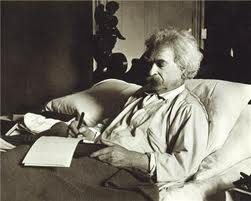
But when we are in that hour, there is no turning back. We know we are in it because time has made it possible for us to write, we have been able to visualise the moment when we’ll sit down at the table and open our notebook (or do it standing up like Philip Roth and Nabokov, or get back into bed like Twain). Everything slows down. We are here and we are not here. We are invisible and we are invincible. We are getting ready to fly. Something unseen in the subconscious is making its way to the surface. In that hour – so rare, so rare – the entire universe is making room for us to write.

Play with Your Food

In Writing on October 8, 2011 at 10:17 am

Sometimes you don’t write. It’s not that you’re blocked or have nothing to say. Life needs to be lived. Or you’re recovering from something. An injury, a death in the family, a rejection. At times you think everything must be written about. NOW! But maybe it doesn’t work like that. Writing is getting done anyway, in different ways, by reading, by living, by listening, by doing stuff, by noticing. Sometimes the best thing for writing – I’m going to regret saying this – is not to write. Maybe it’s a result of brainwashing: If you have nothing nice to say, don’t say anything. So you say nothing. That silence is a weight, a restlessness. It doesn’t do anyone any good, really, and least of all not you. At some point, you must write. Of course “you” is just the second person as a way of avoiding using the first person – like having a bit of poise, literariness, distance. The voice says: Stop talking about yourself so much!

I’ve been reading Katherine Mansfield’s stories in In a German Pension and at the back in the endnotes it mentions when each story was published in The New Age… And between two stories there was a 3 month gap “while Mansfield recovered from an operation” and that got me thinking how hard we can be on ourselves to produce, that in the grand scheme of things three months is not a huge amount of time. But then I’ve been listening to Steve Jobs and reading about him, now that he has died, at the age of 56, and I think, well, three months is a long time and every day not doing what you love is a day lost. So sometimes we lose days. What can you do? The thing to worry about is whether we lose the love for the thing we love doing.

Maybe it’s okay to take a break and do other things, play, try out different art forms, different genres. Sometimes writing itself is not enough. In his new show, Akram Khan uses a variety of genres, bringing all sorts of ways of telling stories onto the stage, not least of which was some magical animation that was projected onto a large net screen behind which Akram danced and so became part of the animation.

What else can you bring to your writing life? Belly dancing? Comics? Singing? Flower arranging? Pressed flowers on the page? What if you could create the kind of book you love, if that book was not just made up of words on the page, if there were drawings, too, and music, and voice, and recorded sounds, and a video, but to keep it within the physical book. So, to take what we’re doing online, what multimedia artists are doing online and put it in a book. Now that book production and music and sound-recording are becoming so affordable, what’s to stop us creating a book that does more? A paper object with pages to turn, but that feels like magic, that can surprise, that can… Ah yes, the voice says, but that’s the computer, the Kindle Fire. Maybe it is, but there are no pages to physically turn on the Kindle. Do you mean a pop-up book, then? Do you mean a book with pictures? Do you mean scratch and sniff? Do you mean a book with those little raised bits that you press on and it makes a sound? Do you mean a comic book? Can’t we play with all of them, try all of them, and see what comes out, see what happens, dare to do something that is not just one word, then another, then another… and succeed or fail at it, whatever that “it” turns out to be.

Fun apps to play with: Comic Book, Garage Band, VoiceRecorder

Writing Is Dancing

In Writing, Writing Workshops on August 21, 2011 at 10:19 am

There is a natural progression from writing to painting to dancing. Watch the hands move as you write or type and then make the gestures more expansive, make the space you fill bigger, move your hands in the air, pick up a brush, paint, but keep moving your hands, move your body, move your feet and you’re dancing. Sometimes I think that it’s that dancing energy, that fluid movement in the world, the longing to fly, that we try and distill back into our writing, that somehow writing is a distillation of movement in the world, that to writing is the opposite of… I almost said life, and maybe that’s what I should have said.

To write is to stop. To stop moving in the world, to stop interacting, to stop, even, procrastinating, putting off the writing itself, and yes, a lot of energy goes into that, a lot of writing time, or what could be writing time, goes into avoiding writing. Writing is a screeching to a halt; most of the frantic and frenetic movement happens in our head. Sometimes, of course, it is not like that and writing is a relief and an oasis and a good place to go to, even daily, because there are periods in my life – I say periods, but it’s more like a few days; if I’m lucky, weeks – when I turn up to write every day, when it is part of a daily movement, when “Writing” doesn’t feel like a chasm or an unearned luxury or the most terrifying thing to do.

Sometimes we have to live and not write. Some of us are better at writing than living. So when there is not much writing happening, it feels like the whole of life is meaningless, disrupted, fragile. Of course, the only cure for this is to write. Sometimes a workshop helps. I went to a workshop recently and I relished the time we had to write and I smiled to myself when things that I liked came out, whole sentences that I knew I’d be able to use in The Book.

It was a dancing and writing workshop. We danced for a bit, then wrote for a bit, then took a break, and when we came back, we did the same again. I didn’t love the dancing bits. They felt too prescriptive, too much like hard work, but it also made me think how some of the stuff we were doing was, for other people there, quite basic. I don’t follow instructions well, and there were a lot of instructions about breathing and this foot and that foot and left and right. However, when we got to the writing, I was so desperate to write, gagging to write, that my pen didn’t want to stop moving on the page. What a relief to be writing again, what a relief to be able to dance the way I know how, or at least in a way I feel comfortable. To dance on the page, to move around, to be silly, playful, to fly, to pirouette. Writing is where we can do everything and anything, be anything, be everything.

I think life can give us a hunger for writing. The fuller our lives the hungrier we are to write, the more we have to bring to the page. I’m not sure if that’s true. It sounds like it could be. Just having a relationship, any relationship, is enough to feel one’s life is full. I think reading can provide that… a good book is worthy, healthy company. A good book makes us want to go off and write. A good book makes us feel that we, too, can dance on the page. A good book is like a good writing instruction, a good prompt… it gives us instructions without saying anything… instructions by osmosis. At the moment I am reading Dany Laferriere’s Why Must a Black Writer Write about Sex?

Light and Night

In Writing on August 9, 2011 at 1:22 pm

This was written on Saturday, just before the London riots began, before the nights brought stories of their own.

Writers need the dark and painters need light. Or: Name a painter who worked at night. Painters need light to see; writers seem to need the night for that. Light is not an inspiration for writers, not on the whole. Bomberg went in search of light. Wherever he went it was to find the perfect light to paint in… whether to the Cairngorms, to Cornwall, to Palestine for a few years, to Ronda on and off until eventually he settled there. If anything, he was a painter who needed light.

I am grateful for the night. The time when everyone is sleeping, when nothing can interrupt a train of thought, when you don’t have to come up with techniques to block out sounds and expectations and distractions. You can own the night. And maybe this is connected to the dreamspace, to touching the subconscious. The further you go into the night, the more chance you have of bringing something back from the underworld. Gifts. Magic. Answers.

Have you ever seen a writer standing in the middle of a wheat field with a notebook in hand?

Stories happen at night. Around a fire. Candles burning. Daytime is for productivity. I write mainly during the day. Mainly in the morning, just on the other side of the dreamspace. The novel needs productivity, perhaps. Needs the light. But it’s more about the light of the subconscious, the light of continuity… because when painters work on a specific painting, a landscape in particular, they need the light itself to be consistent, yet the undertaking of a novel, even a short story, cannot rely on the same light for months or years on end. But maybe it does. And that light is not a physical light. It’s more about faith. The light of believing in a project.

Nightime feels infinite, because in the end you will eventually go to sleep. With the day there is lunchtime, there is a phone that will ring, a postman who will knock. But with the night you will be eased into the dreamspace, which is infinite. Writing is a retreat from the world, and that is easier to do at night. No one expects you to be available at night. And yet a painter at work during the day is clearly doing something… it is easier to leave a painter alone. A writer at a desk does not seem as occupied as a painter in a wheat-field. Don’t disturb the painter until the light begins to fade.

The light at night is more reliable, more consistent than the light during the day.

Time and Napping

In Writing on August 8, 2011 at 11:02 am

Napping keeps you close to the dream world. That space of almost disappearing. The going in and out of the subconscious, then waking into consciousness and you carry fragments up with you, images of yourself doing things you’d never have imagined in waking time, like dancing with someone much bigger than you, but still you dance like those ice skaters who throw each other into the air and land back down, gracefully, catching each other even, and then they keep skating along, like ballet dancers. It’s a space almost impossible to write about because everything happens at once, quicker than it takes for words to describe. I often hear writers say that the reason they write on the computer and not by hand is that when they write by hand they can’t keep up with their thoughts. Do we need to keep up with our thoughts? Can we ever keep up with the simultaneous goings on in our brains?

But that’s not what I want to think about. I’m thinking about that dreamspace, the napping space, the dipping in and out of the subconscious just to see what’s there, just to get glimpses of the pictures and dramas and moments it can create, what it has to offer.  In our waking hours we get so little opportunity to visit that space, especially if we’re always doing things, always busy, working, shopping, relating. That dreamspace is so completely ours. It’s a space we want to get to in our writing, those moments that happen in our writing when we are amazed at how something appeared to us in a story we’re working on. As in: where did that come from? Like when a character does something unexpected, when a metaphor appears to us so perfectly and precisely formed. Those moments in writing when we lose control, when we, that person we know who functions in the world, no longer exists, we have disappeared and words appear on the page despite that, no because of that.

Time to nap is a gift and time to write is a gift. Only when we’re finished with the hunting and gathering can we write. And nap. I want to look up in Lewis Hyde’s book The Gift to see what he says about hunting and gathering and gift giving. Are artists the only ones who structure their world so that it includes the gift of time and napping? Or does the compulsion to create make us find ways to map out a life that facilitates, that enables napping and time to write?

Napping is both escape and fuel. Although I don’t think “fuel” is quite the right word. Fortitude, perhaps is better. Writing is retreat and strength. Going away makes being here possible, more bearable. And being here is food for those moments, those stolen minutes and hours when we disappear from sight in order to write. Hoping in those hours to disappear even from ourselves into what we are creating.

PS. Just a quick look at the chapter “The Commerce of the Creative Spirit” in Hyde’s The Gift offers up these, eh, gifts:

An essential portion of any artist’s labor is not creation so much as invocation.  Part of the work cannot be made, it must be received; and we cannot have this gift except, perhaps, by supplication, by courting, by creating within ourselves that “begging bowl” to which the gift is drawn.

and later:

Just as treating nature’s bounty as a gift ensures the fertility of nature, so to treat the products of the imagination as gifts ensures the fertility of the imagination.

Silence

In Writing, Writing Workshops on August 1, 2011 at 9:25 pm

I love the silence of a writing workshop. People around a table writing together, everyone focused on their own page, the movement of the pen across a blank page, slowly filling it. The occasional quiet whistling of nose hairs, the scurrying of the nib across the page, tapping the i, again and again, especially with words like biking and inimitable and invisibility, the tick tick, or the tick tick tick. The pausing to think, the surprise of a word or thought that is unexpected.

Go somewhere quiet.

Somewhere where there is no noise. Somewhere where nothing can disrupt a thought except thoughts themselves. Somewhere where it is just you and the landscape. And the more you write when you are there the further you will go from thought, deeper, until there is just story, pure telling. For a few weeks when I was in the middle of nowhere in New South Wales, Australia, somewhere outside of Nowra, at the end of a nine kilometre dirt-road, I had days of complete silence. Even an hour a day was enough. I think that’s where painters go to paint landscapes, what they search out, that place that takes them somewhere inside, a place in them that is reached when they are in the landscape and all there is is you and what is around you. The past doesn’t matter, and narrative doesn’t matter, and all you want to do is put the trees onto the page, and the cows, and the sky, and the wombat that’s ripping at the grass with its teeth, the kangaroos that come down from the hills to graze at dawn and at dusk. And the light that is changing. And the river that snakes its way through everything.

Here in the city the noise is constant. The whirring of the extractor fans from the pub, the jabber of the whatever it is that comes out of the door of the William Hill betting shop across the road, scores and races and football matches, and the drilling that started this morning – again – because whoever it is who digs up roads is digging up this road for the second time in the past couple of months, and the traffic, although somehow traffic doesn’t disturb, it is the necessary sound of the city, almost a natural sound, like water, or passing comets.

The Rule of Two, Part I

In Writing on August 1, 2011 at 10:24 am

Take six random books. For example, in a recent workshop we read six novels and collections of short stories. Sweetness by Torgny Lindgren, A Small Place by Jamaica Kincaid, Drown by Junot Diaz, The Lover by Marguerite Duras, Alessandro Baricco’s Silk, and a collection of short creative non-fiction pieces called Sentimental, Heartbroken Rednecks by Greg Bottoms. They are all books I love, and it was a joy to share them with others and engage with the books as a group of writers.

Looking back at all six books I started to think about what they all had in common, to ask myself if there were certain threads that ran through all six, and if through all six, then maybe through all good books. All six books were concerned with memory, with the reliability of memory, and the telling of what has happened in the past and its bearing on the present. All six deal with the relationship between then and now, between there are here, between the way one/a character is now in relation to how they were then. Silk may not be so strongly about these themes, but all the other five very much are.

So I started to wonder if there is a rule of two in storytelling. Two time frames, two places, two versions of the I or the character/protagonist (I don’t like that word “protagonist” – it’s too academic, it doesn’t sound like a word with flesh and blood)… and is every narrative an attempt to reconcile the two, the two geographies, the two versions of the self, all in the face of the passing of time and the conflicting retellings that happen over time and that come about because of different points of view. We are not the only tellers of our own story.

Is the story always, at any point in the telling, only about two people, and if there is a third, then the third is observing. Is this about conflict? Can drama only happen when there is a rubbing together of two… two people, but also two time frames, two places, two versions of the self. Rub two together and the sparks begin to fly. Does this mean we are never alone? There is always memory, there is always a plan. What of stillness? What of emptying the mind? Is there story in that place? Those moments when we are alone in nature, meditating, and we are – just say it – at one with everything. is it only then that there is no two? Is every story the movement between two states of being? Is this a question that’s even relevant to fiction?

The Rule of Two, to be continued.