Shaun Levin

Time for a New Book

In Writing on April 3, 2016 at 2:51 pm

Not until you start putting together a collection can you know what it’s about. In the beginning, the motivation is the idea itself. A book. A new book. It’s been a while since the last one. You have, in a variety of folders on your desktop, various stories and essays that have been published over the past 24 years. You start by creating an inventory, the first draft of a contents list. You create a new folder and copy into it all the pieces you’ve already published, minus all the stories that appeared in your first collection ten years ago. The truth is, you finished a novel and sent it out to a million agents – at least a million – and to some publishers, and 10% of them sent back their no-thank-yous. The rest, if one was the waiting type, one would, eighteen months later, still be waiting for. You figure that in the meantime you might as well put together a collection of stories and essays.

At the new bookshop up the road, you stumble upon Hanif Kureishi’s Love + Hate: Stories and Essays, and you take it as a sign that the two things (things?!) can go together. You fell out of love with Hanif Kureishi about ten years ago, but this book has revived some of the love you’d lost.

So, once you’ve packed the folder with your stories and essays, you print them out.

By you I mean me. I.

I’m surprised how many there are. I give myself a pat on the back. Well done you. Well done. Not bad at all. Already I’m feeling better about things. The piece I like the most is a gratitude piece, a list piece about the writers and other humans who’ve made me the kind of writer/human I am today. The essay was published in a collection three years ago. It feels like a good place to start. The call in the call and response. The response being the rest of the book-to-be.

The New York piece comes after that, then the piece set in Abney Park Cemetery, then another one and another one, and a theme starts to emerge. A book that was going to be a collection of twenty years of sex writing, is turning into a book about immigration, London, Tel Aviv, rootedness, rootlessness. The pieces seem to flow from one to the next. The book gains its own momentum.
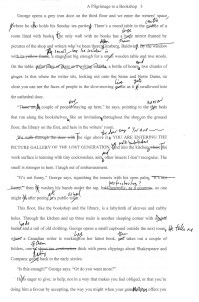
Shaun Levin edited page

From an essay on Shakespeare and Co Bookshop in Paris. Originally published in Hebrew in Masa Acher, a travel magazine.

You read through the book. You edit as you go along. From a distance of 10 years, 5 years, a couple of years, it’s easy to be ruthless, enjoyable even. Look how sharp I am. I feel focused, clear. It’s like you’ve been training for this. It feels strange not to be tormented by doubt and the chaos of creation. Cleaning things up is fun. Being streamlined.

Then you get to a story that refuses to comply.

To be continued.
 

Natalie Goldberg and the Uncertain World of Notebooks

In Writing on June 25, 2014 at 3:37 pm

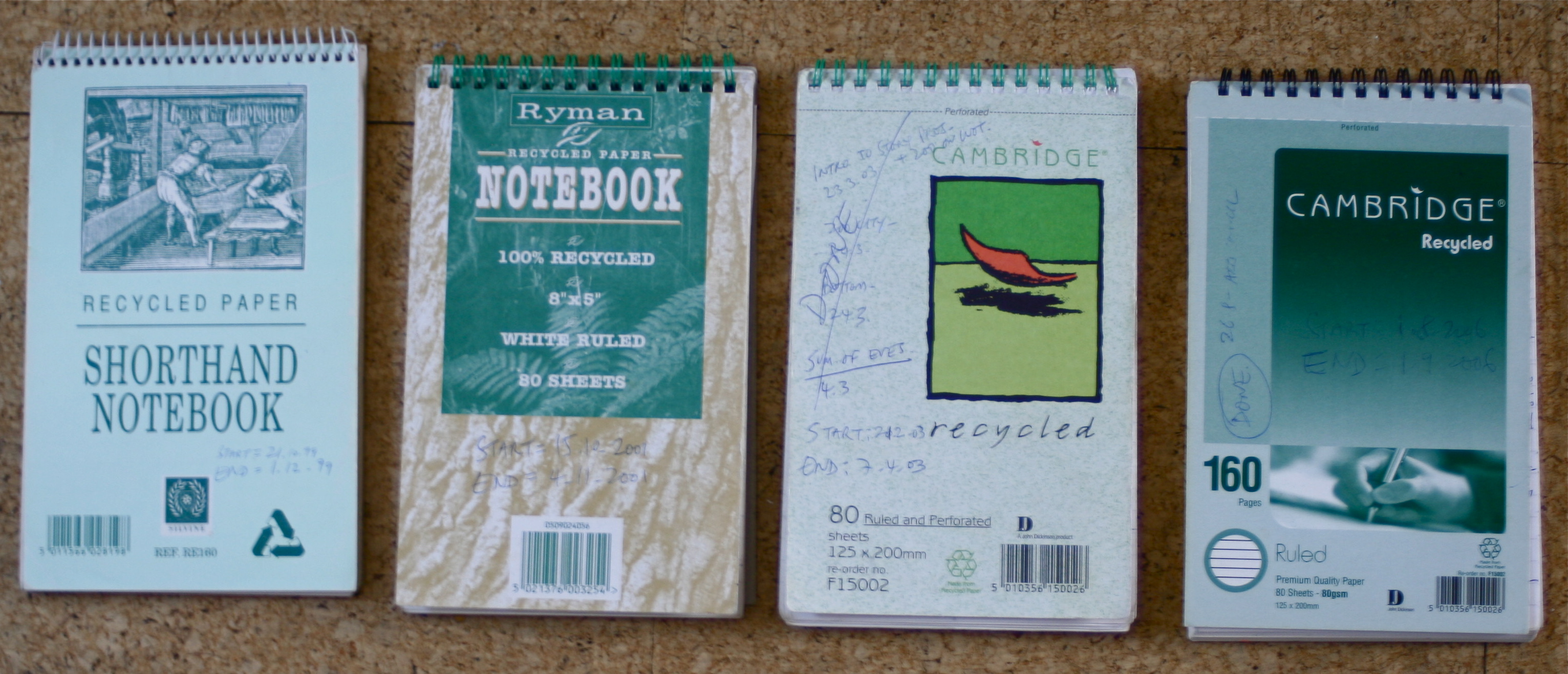
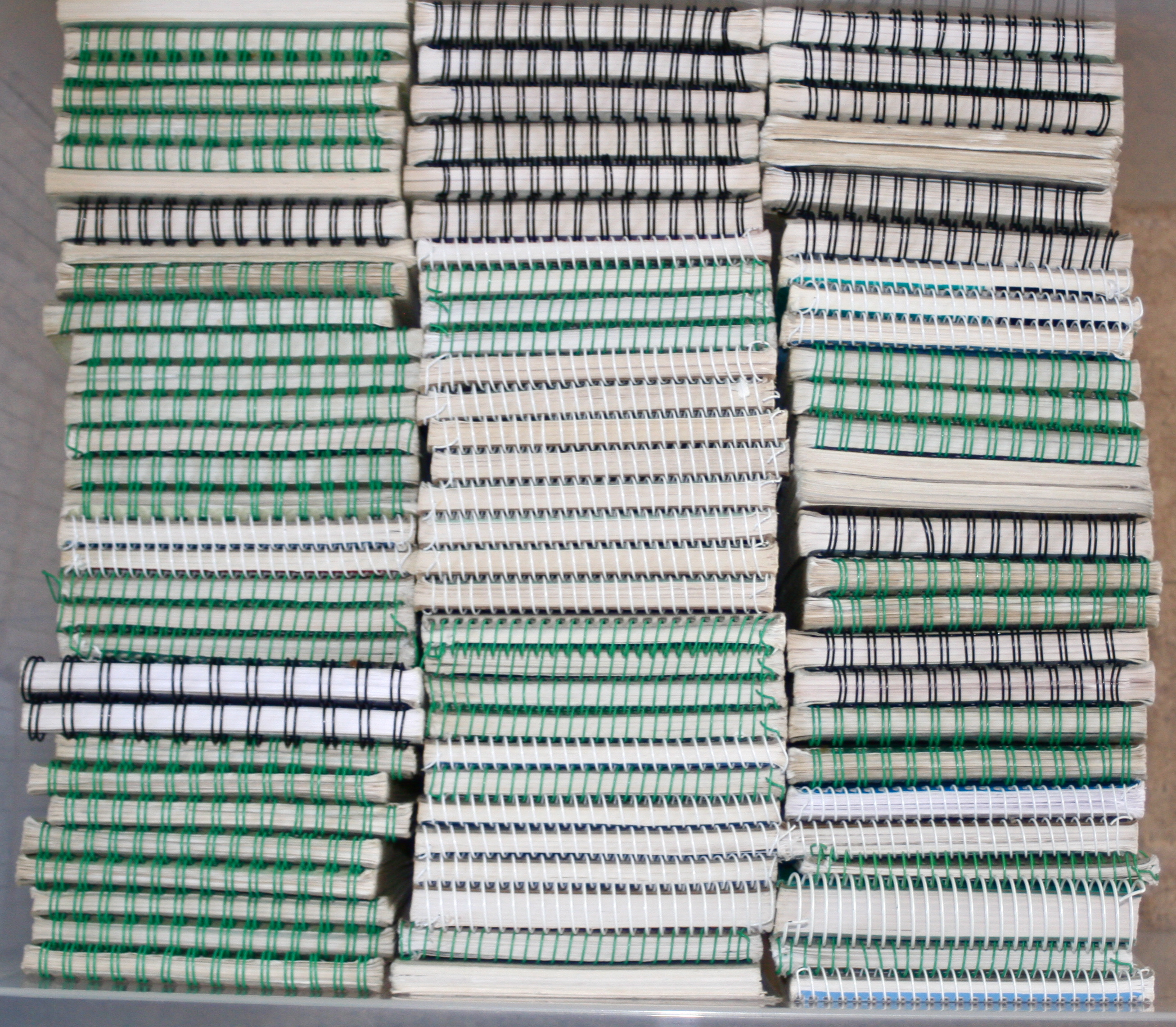
Spiral-Bound NotebooksFor a long time I did what Natalie Goldebrg told me to do. Cheap notebooks were the best, she said, not the fancy ones that make you feel precious about your writing. Keep it simple. So for many years I wrote in spiral-bound A5 notebooks. I wrote with a blue biro, and only blue would do. I met people who wrote in other colours: black, green, someone’s husband used a brown pen, and there were those who’d write with whatever was at hand. Some people weren’t picky. I was picky, and pickiness is a form of superstition, a way to ward off dread. For years I wrote like this in notebooks with 80 sheets, ruled lines, some were perforated, but it was bad luck to tear pages out of a notebook. I’m not sure where I got that superstition from. Many of my superstition are of my own making.

I wrote a lot in those years, almost every day, starting from around 2006 when I first came to London. Natalie Goldberg said to finish a notebook a month, so I did. Some months I was close to the end of the month and still had blank pages untouched, so I wrote to fill the pages, because that’s what I’d committed to doing, what I thought one did to hone the craft. When that happened, I allowed my words to get bigger, letters took up two lines, doubled in size, ten words per page. Anything to finish the notebook, to move onto the next one on the first of the month. I liked the freedom of the bold handwriting, something I didn’t give myself much license to do. I stuck to the lines and stuck to my monthly quota. One notebook per 28, 29, 30 or 31 days.

4 Spiral-bound NotebooksRyman’s used to make a recycled spiral-bound notebook. It was the perfect notebook, and when they stopped making it, I called up head office to ask if they had any left; I was willing to buy whatever stock remained. It was like my rabbit’s foot, my shark’s tooth, my rusty horseshoe had been stolen. But they had none and I moved on, found something similar and forgot about the Ryman’s 100% Recyled 8″ x 5″ spiral-bound notebook until I sat down to write this.

Time passed and things changed; I got busier, needed more than a month to finish a notebook. But I was loyal to the notebooks with the light green covers, the thin paper, the ruled lines. I bought them in bulk from Viking, the office stationery company. When I look back now it seems strange to me that I wrote on lined paper. Recently, someone commented on how straight my lines were – “typical writer,” she said, though I don’t think she knows any – and perhaps those ten years of writing on straight lines have been absorbed into my system, so that when I shifted to the thin plain pages of the Moleskine, my lines were already ingrained, part of the way I saw the page, like those lined pieces of card we’d put under blue onionskin airmail paper when we’d write to people abroad.

About five years ago, a lover came to stay for a while. He was visiting this island from the island he is from. He brought me Mitsubishi Uni-ball Signo DX UM-151 0.5 gel pens in various colours: pink, green, dark yellow, purple, orange. I’m not sure how it happened or why – maybe I was ready for change, ready to try something new, or I wanted to show him I was using his gift, the way you use a gift to mask your ambivalence in the presence of the giver. This was the type of pen he wrote with in a language that calls for fine-nibbed pens; that, or soft calligraphic brushes. By then I was writing in Moleskine notebooks, though I don’t remember the moment my notebooks changed, when I went from the soft covers of the A5 spiral-bound notebook to hard-backed pocket-sized notebooks with double the amount of pages.

Moleskine SpinesFor about 6 years, maybe more, I’ve been writing in black Moleskine notebooks. When a friend gave me a green hard-backed Moleskine notebook last week, I faltered. I couldn’t imagine writing in a notebook other than the exact notebook I’ve been writing in for years. The repetition, using the same notebook over and over, creates a sense that multiple notebooks are one Notebook; after a while, you stop noticing the colour, shape, cover of the notebooks you’re using. Repetition allows you to forget. You don’t have to remember whether it’s the blue one you took to Paris, the yellow one you wrote in while on retreat in Scotland, or the beige one you record your dreams in. On the day he gave me the green notebook, I didn’t have my notebook with me, so I accepted it, cautiously, my superstition unseated.

I’m not always sure exactly when things changed, when I went from spiral-bound to Moleskine, the way I know the precise moment when I moved from blue biro to multi-coloured pens. So now I mark this date, Saturday the 21st of June, the day I ventured into multi-coloured notebooks. I recently started using a black pen, albeit from the same make as the coloured pens. I’ve been experimenting with drawing and black feels like the right colour to do this in. So that’s where things stand at this point in time.

The Consequences of a (Violent) Scene

In Writing on August 23, 2013 at 12:24 pm

It’s a difficult scene. For a while now, you could tell that it was coming, and then it’s here. Three days you’ve been circling it, jotting down notes, working on what comes afterwards. But you’ve resisted going into the cold hard fire of it – the heart of it. That’s a quote from somewhere, or part of a quote, but you can’t remember who said it. It’s not Kafka’s “cold abyss” of the self, but maybe it is that, too. It’s a violent scene. People get hurt. Do horrible things to the characters who are your friends, characters who are close to the character who is closest to you.

Nabokov's DozenYou open a book of Nabokov’s short stories, the one you keep in your desk drawer, the one you use to kickstart a paragraph every now and then, something that’ll take you in an unexpected direction, wake you up. The line is “He had spent all his life in Berlin and its suburbs; had never travelled farther than Peacock Island on a neighbouring lake.” And you get your narrator to say: “I have spent all my life afraid of violence…” And for a while that keeps you going; it’s fuel enough for 5 or 6 lines. The energy of Nabokov’s writing never fails to power your own. But then you run out of steam, or you chicken out.

You wonder if your resistance is perhaps a sign that this scene doesn’t need to be written, that it’s not the right scene for the book and maybe you’re just adding high drama because someone said – whose rule was it? – that you should make something bad happen to your character just to see how they’ll deal with it. How they’ll deal with it?! How am I supposed to deal with this level of brutality?

It’s not the first time you’ve questioned where the drama should be in your novel.

Is it really necessary to the story? And if you have this unexpected scene in the book, this scene that has suddenly appeared in your third draft, like bad news, like a skiing accident, then what’s going to happen to the rest of the novel, those 30,000 words that come after the scene?

What you really wrote was: I’ve spent all my life fearing random violence and its consequences.” The consequences of a new and unexpected scene in a novel. The unexpected is not something I cherish. I mean relish. So what exactly are you scared of?

  • unnecessary drama
  • violence
  • the impact on the rest of the book
  • that it’ll sound fake
  • that I’m being dishonest
  • that a violent scene messes with my plan to make this an upbeat book

“So I sighed a little, and decided to go.” Another Nabokov line. A just do it line. And another: “He slept badly the night before the departure.” It’s true. I’ve been blaming it on the full moon. Yesterday I was so jetlagged with exhaustion that I couldn’t bring myself to write, not until almost midnight, but today I am back and sighing a little, dipping in and out of the scene, writing bits of it. threads, patches, things that will – have faith! – eventually get woven and sewn together and whatever the consequences turn out to be, you’ll just have to deal with them. Now, go! Write!

And what’s the worst that can happen? You’ll write it and it’ll be wrong and you’ll start all over again. But at least once you’ve written it, it will have been written.